




The short answer
The wedding products that sell: bridal party gifts, guest-table favors, personalized signage and reception decor sold in sets, and guest-experience items like audio guestbooks and disposable camera kits. Add everything attached to the welcome party, the bachelorette and the day-after brunch. Not gowns, not rings, definitely not fresh flowers. The date on the invitation never moves, so delivery time sorts the list.

Why weddings pay better than they look
Weddings pay better because one customer buys for the whole guest list at once, where most dropshipping is a one-item-per-customer business.
A wedding guest list is the real order quantity: the 2026 Real Weddings Study from The Knot Worldwide, drawn from 10,474 US couples married in 2025, puts the average US wedding at 117 guests.
So a bride shopping for favors is buying roughly 120 of them, in one order, to one address.
Steve and Jennifer Chou say they cleared over $100,000 of profit in their first year selling handkerchiefs in the late 2000s, to home embroiderers rather than brides.
Weddings came later, once they added the personalization, which makes the store an existence proof and not a forecast.
What transfers is the shape of the customer base. Chou told a 2023 podcast that 12% repeat customers produce over 36% of revenue at Bumblebee Linens, so capture an email address at checkout.
Which of those orders you can take is a delivery question before it is a product question, and the table below settles it row by row.
Which wedding niches should you sell?
All fourteen are here with a verdict on each: ten worth selling and four to leave alone. Guest experience takes two rows, because its paper and film half and its hardware half run on different clocks.
| Niche | Your slowest order-to-door plus five business days has to be under | What usually breaks it | Verdict |
|---|---|---|---|
| Personalized bridal party gifts | 60 days | Typos and the reprints you pay for | Best start |
| Guest-table favors | 30 days | A supplier with no tier pricing | Best start |
| Guest-experience, paper and film | 30 days | A dozen rigid cameras take more room in the box than the invoice suggests | Good second |
| Guest-experience hardware (audio guestbooks, polaroid stations) | 7 days | A unit that fails on the night, swappable only from stock you already hold | Domestic only |
| Reception decor in sets (table numbers, place cards, signage) | 30 days | Freight, then glass | Good second |
| Groomsmen gift sets (flasks, knives, engraved glasses) | 30 days | Thin differentiation | Good second |
| Bachelorette party kits | 15 days at a month out, counted to the party | A deadline nobody thought to ask the buyer for | Good second |
| Bridal accessories (veils, combs, belts) | 60 days, 7 on the rebuy | Quality variance against the photo | Only if you hold stock |
| Artificial florals (arch flowers, garlands, backdrops) | 30 days | Dimensional weight and crush damage | Domestic only |
| Replacement and overflow stock (spare favors, place cards, a second welcome sign) | 7 days | Nothing on your shelf, no business | Domestic only |
| Bridal gowns and bridesmaid dresses | Does not save it | Sizing, dye lots, alteration time | Skip |
| Engagement and wedding rings | Does not save it | Chargebacks and processor holds | Skip |
| Fresh flowers | Does not save it | A cold chain and a delivery window measured in hours | Skip |
| Anything "designer inspired" | Does not save it | A rightsholder complaint you cannot answer | Skip |
One note on the bachelorette row before anything else: 15 days is the friendliest case, not the typical one. Ask the buyer for the party date and redo that line against it.
The day figures are derived in the next subsection. The breaker and verdict columns are our judgement. The verdict tells you what to do with a row; it is not a ranking of the rows.
Which rows are open to you depends on how you plan to fulfill.
- If you are dropshipping: personalized bridal party gifts and groomsmen gift sets, both off a print partner. The gifts are bought six to four months out, the groomsmen sets later and tighter at thirty days.
- If you are buying in bulk: guest-table favors, reception decor in sets, bachelorette party kits, and the paper and film half of guest experience. One customer, roughly 120 favors, one box, one address. The tier you actually order at decides most of what you earn.
- If you are holding your own stock: bridal accessories, artificial florals, replacement and overflow stock, and the hardware half of guest experience, meaning anything with a battery in it. The money in the first is the panic rebuy a fortnight out. Take them once you can hold inventory, or once you have a domestic supplier you have timed.
- Whatever your setup, skip these: bridal gowns and bridesmaid dresses, engagement rings, fresh flowers and anything "designer inspired". Sizing returns, processor holds, a cold chain and rightsholder complaints, in that order.
On anything with a battery, get the return rate and warranty terms in writing before you list, then hold US stock so a replacement reaches the couple inside the week. Audio guestbooks rent by the weekend as well as sell; our working assumption, which nothing on this page sources, is that renting is the more common choice.
The number that sorts the whole table is the one the second column already names: your slowest recorded order-to-door plus five business days.
How each niche gets its delivery window
Sell only into windows longer than that total: every figure in that column is the near edge of the wave in the buying calendar below, halved. Halving is the buffer, because the couple wants time to open the box, count it and complain about it.
Favors, decor, groomsmen sets, the paper and film half of guest experience and artificial florals are all bought as late as two months out, so 60 days becomes 30. Bridal party gifts and bridal accessories are bought as late as four months out, so 120 becomes 60.
Replacements are wanted as late as two weeks out, so 14 becomes 7, which is also the window for a panic rebuy of a bridal accessory.
Guest-experience hardware sits in that same last wave, so 14 becomes 7 there too.
Bachelorette kits are the exception: the deadline is the party, not the wedding. A party a month ahead leaves a 30-day runway from the near edge of the buying wave, so halving gives 15.
At six weeks ahead the halved runway is 9 days, and at two months there is none left. It is a rule of thumb, not a measured figure.
Start with personalized gifts and table favors
Two rows are the place to start because both forgive the mistakes a first store makes: personalized bridal party gifts at sixty days, guest-table favors at thirty.
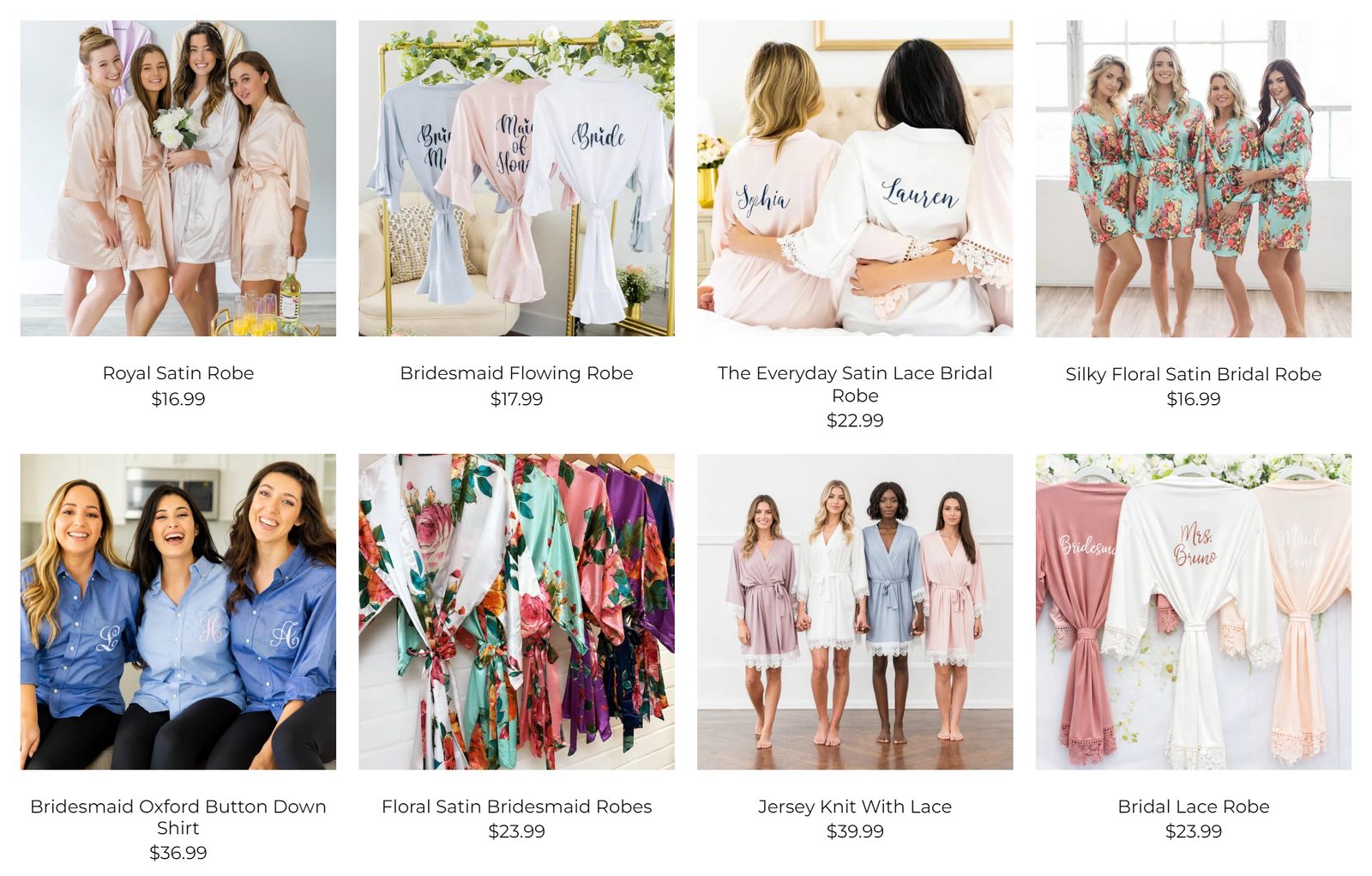
Personalized bridal party gifts. Robes, engraved tumblers, monogrammed totes, hairpin sets, one per attendant, bought four to six months out. The imagery tells you the order is a set before the prices do.
On bridesmaidgiftsboutique.com's robe collection, five of the first eight products are shown on more than one woman, three on hangers and not one on a single model. Those eight run $16.99 to $39.99, which is the ceiling you price under.
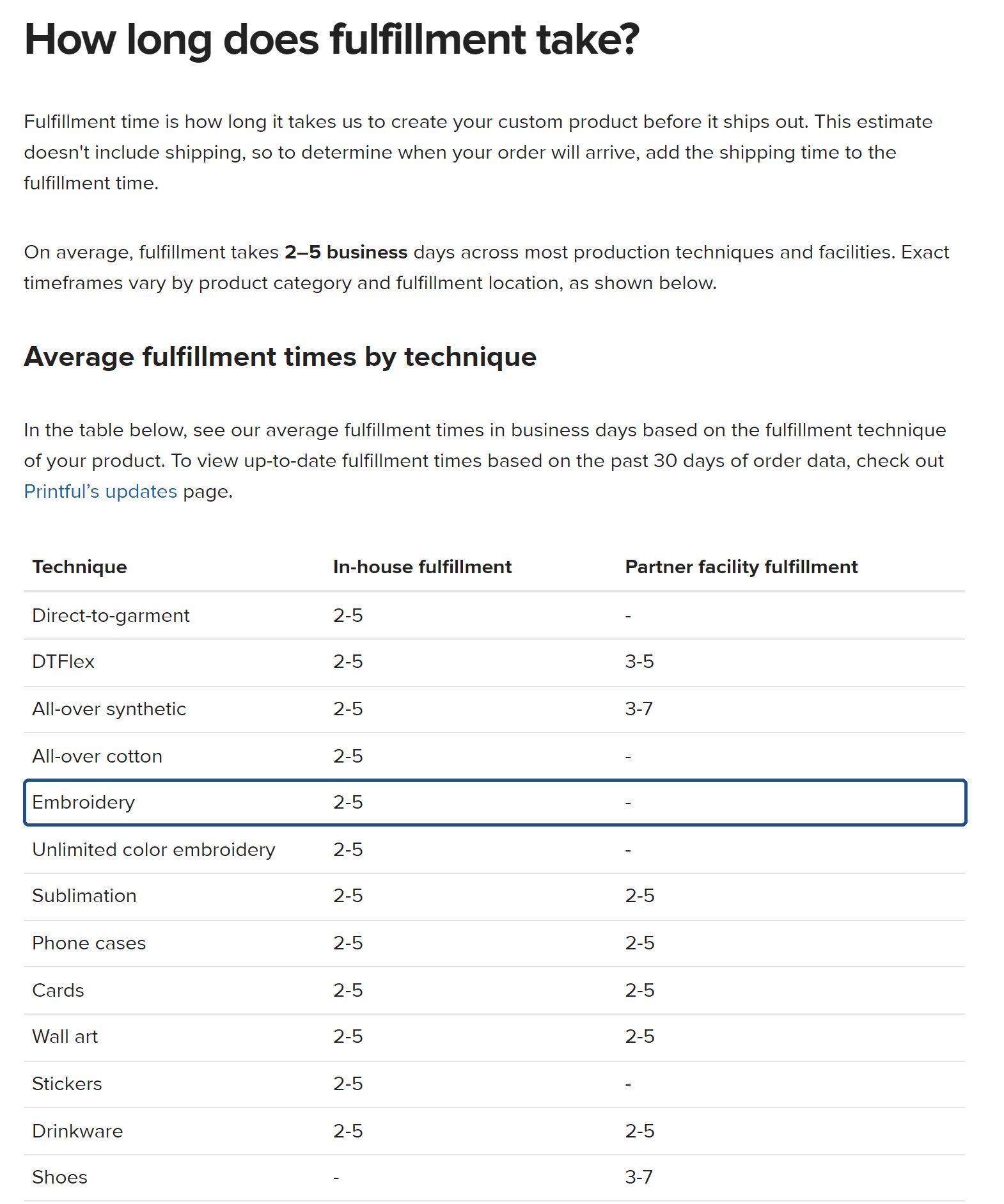
The calendar forgives you here. Printful's own help center puts fulfillment at two to five business days across most techniques and facilities, with shipping time on top.
Sixty days swallows that whole. Sell the same product into the final fortnight and it becomes the worst choice on the page.
The returns cushion is thinner than sellers think. Personalization does not exempt a listing from returns, and outside the EU you must set a return policy on every physical Etsy listing.
There is no per-listing switch for personalization. Where an item can be bought plain or customized, the exception is a line you write in your shop FAQ.
That is a notice to the buyer; it does not stop a refund. Etsy's Purchase Protection may refund a buyer up to $250, shipping and taxes included, without holding you responsible. What it may cover:
- The buyer never receives the package.
- It arrives 7 or more days after the estimated delivery date window given at checkout.
- It arrives damaged, for the first instance in a calendar year.
- It matches your listing description and photos and the buyer claims it does not.
Everything past that is on you. What it does not:
- A genuine mismatch: the item really is not what you listed.
- Every damage case after the first in a calendar year.
The cover is also conditional on, among other things, your stated processing time, valid tracking, a 48-hour reply, an estimated delivery date and duties prepaid on US-bound orders.
Your own typo sits outside all of it, so build a confirmation step showing the exact text in the exact font and have a human read any order inside three weeks of the event. Pick a partner from the print-on-demand supplier guide that handles names and dates cleanly.
Guest-table favors. Keychains, bottle openers, matchboxes, seed packets, koozies, mini candles: the purest form of the guest-count advantage.
Two decisions settle most of what you earn. The tier table is the first: ask for tiers at 50, 150 and 300 up front, then price from the tier you will actually order at.
How you list it is the second. Sell a set of 120 favors rather than 120 units of one listing, because Etsy charges the listing fee again on every extra quantity that sells.
That choice is worth about $24, priced both ways below.
Four wedding niches to leave alone
Four categories fail for reasons no supplier and no buffer fixes: gowns and bridesmaid dresses, rings, fresh flowers, and anything "designer inspired".
Bridal gowns and bridesmaid dresses are the most common wrong turn in wedding ecommerce. Sizing from overseas runs small and inconsistent, dye lots vary between runs, and alterations take weeks the couple does not have.
Scope it honestly, though: this is a beginner screen, not a law. Apparel works for sellers with a fit process, samples, local returns and a capital buffer, and two stores show what that costs.
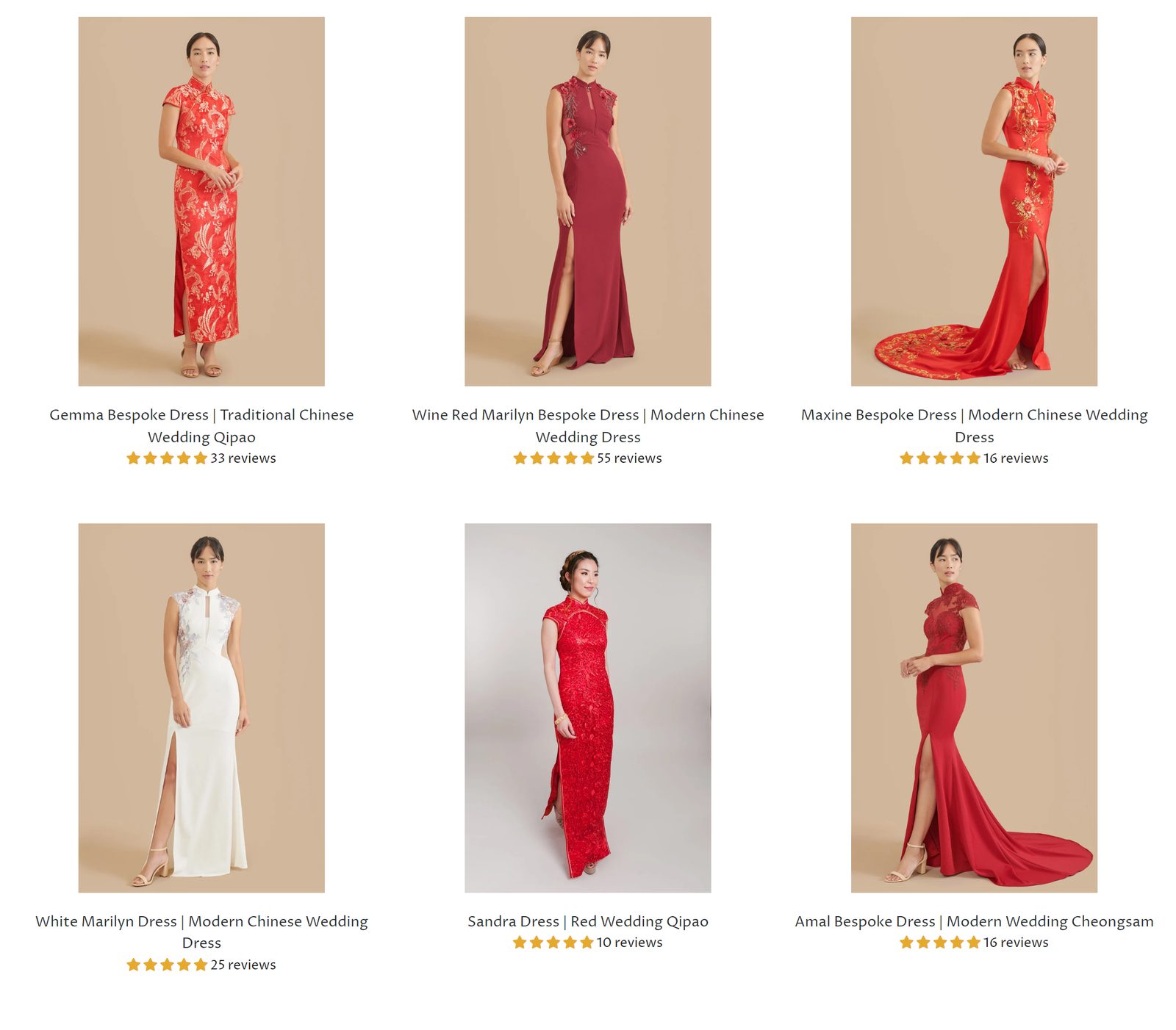
East Meets Dress, founded by Jenn Qiao and Vivian Chan, lets a bride customize her qipao on embroidery and silhouette. Four of the six dresses in the capture below are titled "Bespoke".
A March 2025 Modern Retail profile puts Birdy Grey at $100 million in revenue "last year" selling bridesmaid dresses under $100. The category is winnable, but not off somebody else's dropship feed.
Engagement and wedding rings, and one reason is enough. High order values arrive with fraud attempts, chargebacks and payment-processor holds attached, and one disputed ring can be worth more than a first store's whole float.
The risk lives in the payment rail. Three things would change the answer: a processor relationship, a reserve you can live without for months rather than weeks, and a documented fulfillment trail.
Fresh flowers. Perishable, refrigerated, wanted inside a window measured in hours. A late favor box is a refund, a late bouquet is a wedding without flowers.
Sell the artificial version instead.
Anything "designer inspired". Copies of named gown designers, licensed characters, branded prints. A marketplace can remove a listing on a rightsholder complaint before you get to argue.
The shipping is easy. The legal exposure is why it stays on the list.
How do you know a product actually sells?
Check sell-through on the specific SKU, not on the category, because search volume tells you nothing about whether anyone bought.
A set that moves and a set that has sat in a warehouse for a year look identical in a keyword tool.
Counting sold listings by hand gets you the answer for free, or our product research tool shows sell-through per product in about a minute.
Delivery is worth counting the same way. How many of the first twenty listings for "wedding favors" state a dispatch time in days rather than a platform estimate?
Least competition on delivery is not the same as most profitable, and we hold no order data that says it is.
Photographs are the third check. Read a competitor's buyer-submitted photographs against the studio shots above them, because that gap shows up as returns and one-star reviews, never as a number you can look up.
When do couples buy wedding products?
Couples buy wedding things in five waves, and each wave is a different business. Find the wave your supplier can serve and you have your shortlist.
| Window | What they are buying | Which niche that is | What the window demands of you |
|---|---|---|---|
| 12 to 9 months out | Venue, catering, photographer, the gown | None of them | Not your market. Do not try |
| 9 to 6 months out | Save-the-dates, proposal boxes, engagement-party pieces | Personalized bridal party gifts, bought early | Small orders, long runway. A print partner's production clock disappears here |
| 6 to 4 months out | Invitations, bridal party gifts, bridal accessories | Personalized bridal party gifts, bridal accessories | The party count is already fixed, so she buys the whole set in one checkout |
| 4 to 2 months out | Favors, reception decor, signage, place cards, groomsmen gifts, camera kits and prompt cards, bachelorette kits | Guest-table favors, reception decor in sets, groomsmen gift sets, guest-experience paper and film, artificial florals, bachelorette party kits | The final guest count is in. This is where the 120-unit orders land |
| 8 to 2 weeks out | Welcome-party pieces, replacements, forgotten items, a guestbook handset that failed | Replacement and overflow stock, guest-experience hardware | Stock you can reach today. Nothing shipped from overseas serves this window |
The wave timing above is our own reading of seller order patterns, with no survey behind it. Argue with it if your own order history says otherwise.
The dates underneath it are not ours. The top five wedding dates of 2026 are June 6, June 20, September 19, September 26 and October 10, on The Knot data rather than on the survey above. Two are behind you.
Now count backwards from real dates, in days.
Take one worked example, as at August 26, 2026: September 19 is 24 days out and October 10 is 45. November 7 is a different business from either.
Calling them all "the four-to-two-month window" is how a seller takes a six-week delivery against a three-week deadline.
So print your window on the product page as a date, never as a duration. "Ordered today, delivered by September 4" answers the only question the buyer has.
Sell the whole wedding weekend
A wedding is rarely one event now. The survey behind that guest count puts 71% of celebrations across two or three days.
It names the rehearsal dinner the most popular event, at 75% of couples, and records a night-before welcome party for the entire attendee list at 26%.
Guest experience is the number-one planning priority for 69% of couples in that same survey.
For a seller that is a second and a third occasion attached to a customer already standing in your checkout: a welcome bag, bachelorette tumblers, a rehearsal-dinner sign.
Where to buy wholesale wedding supplies
Email six suppliers, not one, with the same five questions; BBCrafts, burton + Burton and Faire are three places to start that list. One reply feels like progress and leaves you with no comparison and no backup when a factory goes quiet in week three.
Subject: Wholesale inquiry, wedding favors, 50 to 300 units. I run a US store selling wedding favors and reception decor and I am sourcing [product] this month. Five questions, so I can compare suppliers properly:
- Over your last 30 orders of this product, what was your dispatch time, order to tracking number? Your slowest one as well as your typical one.
- What are your price tiers at 50, 150 and 300 units?
- Do you hold stock in a US warehouse, or does everything ship from origin?
- If it ships from origin: what is the DDP landed cost per unit at 150, with duty and clearance broken out, and what HTS code do you declare it under?
- Who is named as importer of record on that shipment, and on whose customs bond?
Send your current stock list and tier pricing and I will place a sample order this week.
Question one is the whole email. Ask for the slowest dispatch time, because the order that ruins a wedding is the slow one and an average hides it.
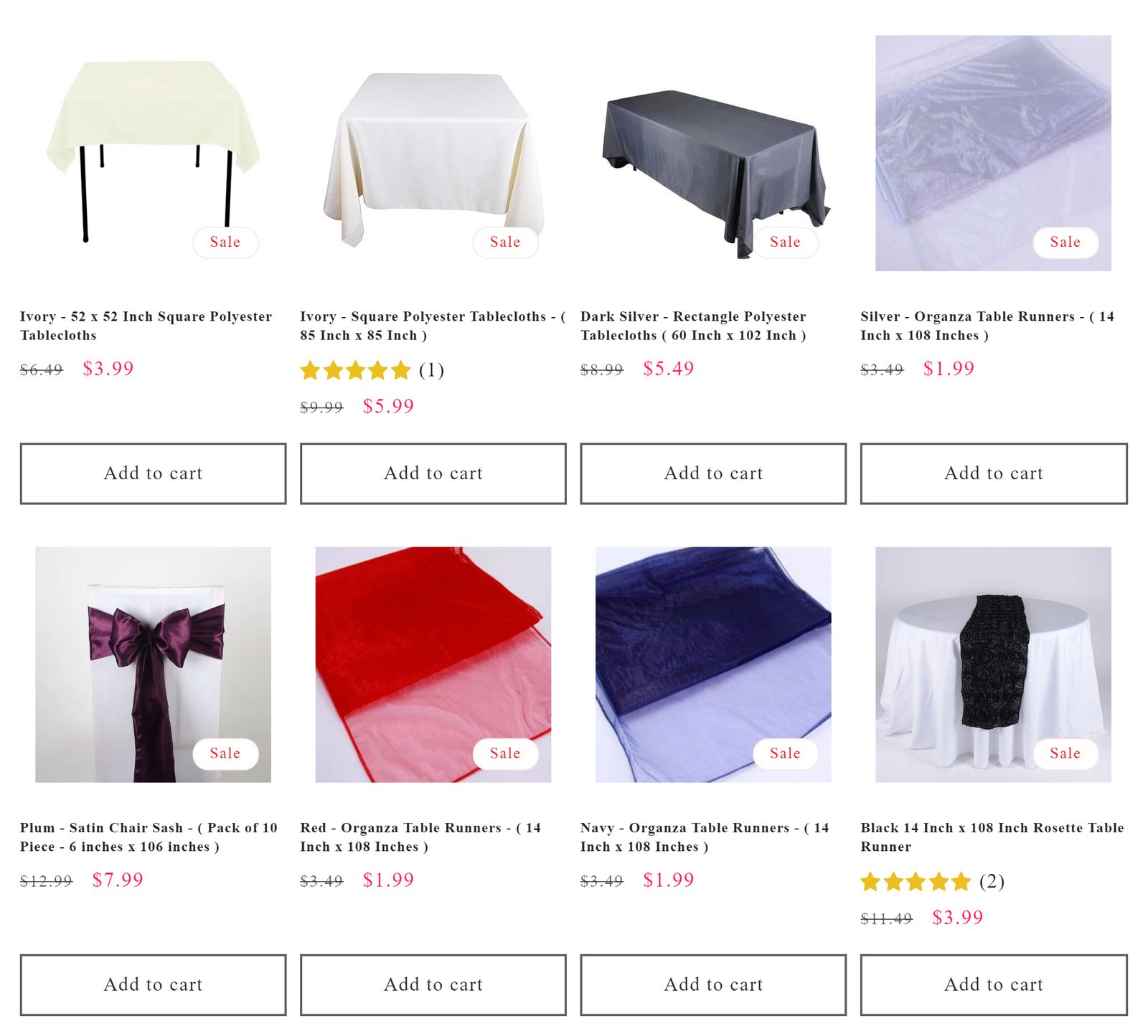
Three real starting points to check your replies against, none of them from our directory. BBCrafts does ribbon, tulle, tablecloths and chair covers, and publishes prices with no account.
Every tile on the tablecloths grid is a sale price, though: organza runners at $1.99 against a $3.49 list, ten satin chair sashes at $7.99 against $12.99. Cost your set off the list, because a sale can be withdrawn.
It also publishes its own processing time, the thing this page keeps telling you to ask for: most orders out in 1 business day, up to 3 or 4 in a heavy season.
Same-day dispatch is express only, ordered before 11am Pacific. The same page contradicts itself lower down, which is exactly why you time a supplier rather than read one.
The Georgia wholesaler burton + Burton does balloons, floral supplies and containers, and its signup asks for a business tax ID, so get your resale license sorted before you apply.
Faire is free for a retailer to join and to browse, and its help center lists lead time and brand minimum among the filters you can search on.
That narrows a shortlist without answering question one, because a self-declared lead-time band cannot separate a supplier's slowest order from its typical one. Brand minimum bears on question two.
Beyond those three, the US dropshipping suppliers list is a free place to start. Avoid a middleman either way: every handoff adds days to the number you measured.
How do you time a supplier before you sell?
Measure it yourself, because nobody publishes reliable order-to-door times for wholesale wedding suppliers and neither do we.
A supplier advertises a dispatch time, which is when a label gets printed, not when a box arrives.
It takes an afternoon to set up and about three weeks to finish, which is the fortnight step 3 waits out plus the second cycle behind it.
Budget roughly $200, our own working figure for samples and postage at these quantities rather than a quote from anybody.
- Configure the SKU the way you would actually sell it. Personalized, at the tier you would order at, not one blank sample unit. A supplier who will not run a personalized sample at a small quantity has told you something about your first busy month.
- Order it from three suppliers, to your own address, at your own expense, and record four timestamps for each: order placed, tracking number issued, first carrier scan, delivered.
- Do it again from the two best performers once all three have arrived, about a fortnight after you placed them. One cycle tells you nothing about variance, and variance is what costs you a review.
- Take the slowest order-to-door across both cycles, not the average. Add five business days.
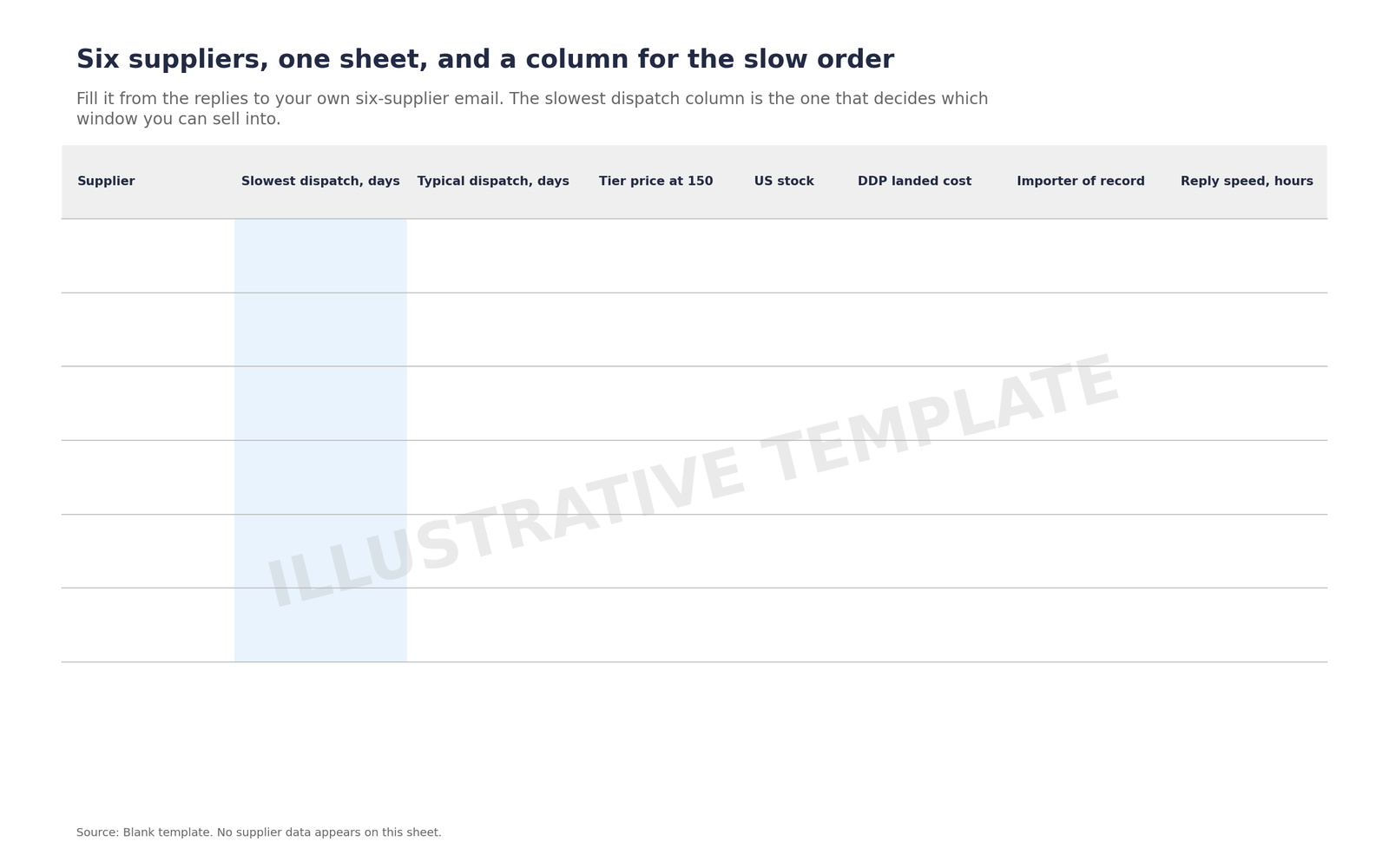
Be honest about what that total is. Five orders across two cycles is a provisional range, and nothing you can run in three weeks tests 120 personalized units in the last week of September.
So rerun both cycles in the busy month before you take volume into it. Until then, sell into windows that leave your range room to spare.
Consistency beats speed. A supplier who reliably takes nine days beats one who averages five and sometimes takes twenty, and when your supplier lets you down goes deeper on the fix.
How much is left on a 120-unit favor order?
About $146, before you have paid a cent of postage. Here is one order worked once: a bride buys a set of matchbox favors, one checkout, one box, one address.
You order at the 150-unit tier and sell her 120 of them with shipping included. Both unit prices in the table are working figures rather than a supplier's quote. Every conclusion below survives you substituting your own.
| The order | How it is figured | Listed as one set | Listed as 120 quantities |
|---|---|---|---|
| What she pays | 120 favors at $3.50, shipping included | $420 | $420 |
| The goods | 120 units at $1.95 on the 150-unit tier | $234 | $234 |
| Listing fee | 20 cents once, or 20 cents again on each additional quantity that sells | $0.20 | about $24 |
| Transaction and processing fees | charged on the whole order, shipping included | about $40 | about $40 |
| What is left before your own postage | what she pays, less the three cost lines above it | about $146 | about $122 |
| Offsite Ads fee, only if the sale came from one | 15% for a shop that has never made $10,000 in any 365 days, 12% for life once it has, capped at $100 per order | $63 | $63 |
Those listing and transaction rates and that payment processing rate are Etsy's own; the price is yours.
The advertising fee at the bottom sits outside the subtraction. It is charged on top, and only on a sale the platform can attribute to an ad click within 30 days.
One line is yours to decide outright: the same box sold as one set pays the listing fee once and sold as separate quantities pays it over and over.
Second comes Offsite Ads, the fee that actually bites. On this order it takes 43% of what you kept before postage and a bigger share of what you clear after it.
Until your shop has made $10,000 in any 365 days the program is optional and you are enrolled by default, so opt out on day one.
Once it has ever passed that mark you are in for the life of the shop at the lower rate, and the opt-out you took while you were under it stops applying.
Get a real quote for a box of 120 favors, because postage is the line most likely to surprise you.
And what is left is not cash: you bought all 150 units to reach the tier, so 30 spare favors are $58.50 of stock on your shelf when this order ships. Storage, breakage, returns, your own advertising, your own hours and tax all sit outside every figure here.
Do you pay import duty on wedding favors now?
Yes, on most of what a favor supplier will ship you, and the rule is new enough to catch a seller who priced a lane last year.
The cheap overseas favor used to arrive duty free under the $800 de minimis exemption. The rule that closed it suspends the exemption indefinitely for every mode but the post, from June 24, 2026.
A companion rule closed the same route for mail from the same day. So your parcel needs an entry now, which somebody has to file, on top of duty at its own tariff line.
Which line applies depends on the product and where it was made, so the only honest answer is your own classification.
Two narrow categories of mail shipment need a formal entry, or the voluntary Entry Type 13 test, for shipments at $2,500 or less, in its place. The one that catches a favor importer is anything carrying a Chapter 99 tariff, which is where China-sourced goods land.
The other is anything answering to a second federal agency, so plan for FDA or CPSC paperwork if you sell cosmetics or children's products; importing into the USA covers the filing.
October 22, 2026 is the compliance date on both categories. The entry requirement itself is already live.
What do duty and entry actually cost?
Enough to close most of the gap at the higher tariff line, less than half of it at the lower one. That same matchbox favor is cheaper from overseas than from a domestic supplier before anything is added at the border.
Duty goes on first, at whatever line the product classifies under, and both unit prices below are working figures rather than supplier quotes.
Then the entry fees, where the arithmetic stops being general. It prices the ordinary case, a shipment moving through an express carrier's hub, where 19 CFR 24.23 sets one government charge per individual air waybill or bill of lading, billed to the carrier and passed to you.
The regulation prints only the base fee, so the payable amount comes from CBP's annual inflation notice: $1.34 for fiscal 2026, which becomes $1.38 on October 1, 2026.
What actually bites is the carrier's own clearance charge, which is not a government fee at all. At an illustrative $15, the two together come to 10.9 cents a unit on a 150-unit shipment.
A parcel entered by post, outside an express hub, can cost more than that, so get that figure from your own supplier before you price the lane.
| Per favor, at 150 units | Overseas, at a 10% tariff line | Overseas, at a 30% line | Domestic |
|---|---|---|---|
| The unit | $1.35 | $1.35 | $1.95 |
| Duty | 13.5 cents | 40.5 cents | none |
| Entry and clearance, express lane | 10.9 cents | 10.9 cents | none |
| Landed, before freight | $1.59 | $1.86 | $1.95 |
| What it saves against domestic | 36 cents | 9 cents | none |
At the higher tariff line the saving is about 9 cents, which does not pay for the extra transit, and on most lanes the freight bill closes it entirely.
At the lower line the saving is wider and the call is yours. Prepaying duty is also a condition of Etsy's cover, above. Settle it with questions 4 and 5 of the supplier email above, because a DDP label means nothing if the documents name you as importer of record.
What wedding products ship well?
Gifts and favors ship well; glass and anything bulky do not; anything with a battery in it has carrier rules of its own, so read them before you list an audio guestbook.
Bulky goods bill on air. Multiply length by width by height in inches, divide by your carrier's dimensional divisor and compare the result against the actual weight. You pay for whichever is greater.
A 24 by 18 by 18 inch box of silk florals is 7,776 cubic inches, and at a divisor of 139 the shipping bills at 56 pounds even if the box weighs nine.
Divisors differ by carrier, service and account. Read yours off your own rate card, then get one real quote with your actual origin, destination and date.
Glass breaks and you pay twice. Charger plates, votive holders, cylinder vases, cake stands. Ask two questions before you order: what is your breakage rate on this SKU, and do you double-box?
Then budget breakage as a line item, because decor is fine until it is glass.
Where wedding sellers lose money
Four shapes of a bad month, each with the fix that would have prevented it: two dye lots of the same blush, a sample the production run does not match, July's money spent on August's advertising, then a window your supplier cannot serve.
Two orders of "blush" arrive as two different pinks. Same supplier, six weeks apart, different production run, and the bride is holding them side by side.
Fix: for anything color-critical, order the full quantity in one lot and write "single dye lot" into the order email.
The sample and the production run are not the same product. Thinner card stock, duller finish, a slightly different white.
Fix: keep the approved sample, photograph it next to a ruler, and reference it by date in every reorder.
July is enormous, February is quiet, and July's money went on August's advertising. Wedding stores rarely fold in the busy months.
Fix: decide at the start of the season what share of each month's revenue moves to a separate account, and move it on the day it lands.
You sold into a window your supplier cannot serve. Six-week delivery taken against a three-week deadline, because nobody counted the transit.
Fix: sell into windows longer than your slowest recorded order-to-door plus five business days, and print the date on the product page.
What does the first week cost?
$500 and a week, with none of it going to a logo and none to advertising. The figures are planning numbers with nothing quoted behind them.
They are here because a plan with no numbers in it cannot be followed.
- Day one, $0. Take your slowest recorded order-to-door plus five business days to the verdict table and see which rows it leaves open. If it leaves none, the supplier is your problem, not the niche.
- Day one, $0. Send the six-supplier email. All six, same five questions, one afternoon.
- Days two to four, about $60. Build one product page on your own store, on a domain and a month of hosting, with the rest going to packaging for a test box you ship to yourself. Three tiers named by guest count, up to 75, up to 125 and up to 200, with the event date as a field.
- Days three to seven, about $120, then $80 in week three. Place the configured sample order with three of the repliers and start the four timestamps. Wait until all three have landed before you pick the two best.
- Days five to seven, $0. Run the demand test so it cannot hurt you. Build the delivery date from the slowest dispatch time quoted to you in writing, plus stated transit, plus the five-day buffer, plus a fortnight. Cap the listing at one order and say so on the page.
- Hold back $240. The steps above commit the other $260. Release the reserve only once all three of these have happened: two suppliers back with a tier table in writing, the slowest of your five samples inside the verdict table's day figure after the five business days, and one paid order off the test page.
Then be honest about what $240 buys. It buys a 50-unit proving order at the worse unit price, and postage. It does not buy a full tier of stock.
Fund the real tier out of the first order's cash, or start with $800. If no supplier's slowest sample fits your window, you do not have a business there. Move to a longer window, or find a domestic supplier and rerun the test.
So pick the category tonight, get the six emails out and have the three-tier page live before the first sample lands. What is the slowest order-to-door you have actually recorded from a supplier you still use?
FAQs
Most US wholesalers ask for one, and some ask for a business tax ID at signup, as burton + Burton does. Sort it before you start emailing, because the application takes days in some states.
Test on Etsy, build on your own store. Etsy gives you traffic on day one and a single free-text personalization box, where your own store gives you the event-date field, the three-tier pricing and the delivery date printed as a date.
Both work, for different categories. Print-on-demand and dropshipped gifts are fine four to six months out, but anything bought in the final fortnight needs stock you can reach today.
In five waves, where the wave decides the category, from venue and catering twelve to nine months out to replacements in the last eight to two weeks. Count backwards in days, never in whole months.
You refund it, and you expect a review that says so. There is no recovery move worth writing down, which is the whole argument for the buffer.
About this article
About the author



1 Comments